
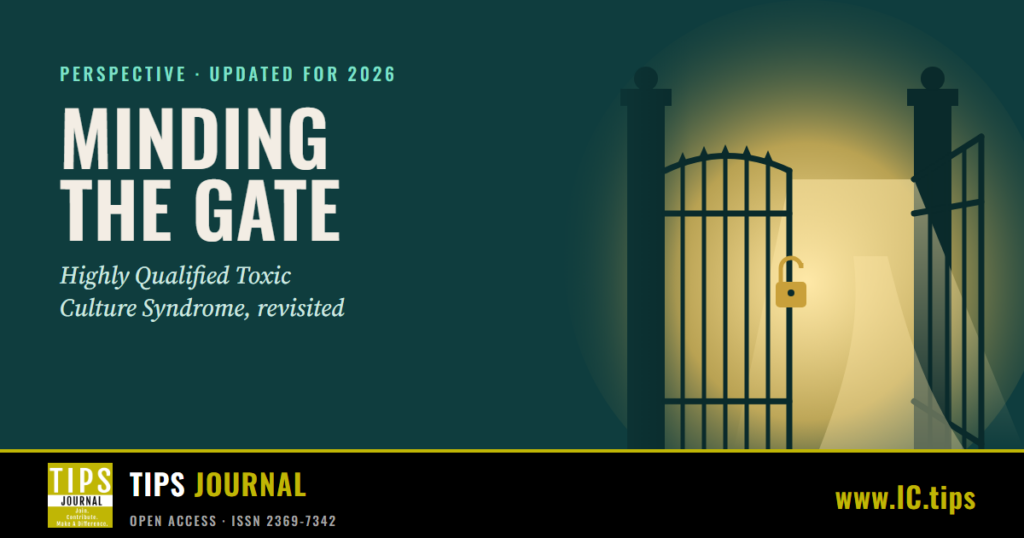
I first wrote a version of this piece in February 2017 and posted it on LinkedIn, and later on my personal blog. That blog is gone now, but the problem it described is not. It is time this article found its home here, on the TIPS Journal, updated for 2026.
Early in 2017 I sat in a hospital board room presenting several innovations that our team believed could make a real difference in healthcare. Everyone around the table was highly qualified in infection prevention and control. They were smart, experienced people.
But a dark cloud hung over that room, and it smothered the message before I got very far. The responses kept coming, one dismissal after another. None of them was about whether the innovations worked. They were about who gets to walk into that board room and who does not.
I called it Highly Qualified Toxic Culture Syndrome. It was not the first time I had seen it, and it was not the last.
The Gatekeepers
Talk to anyone who has tried to bring something new into healthcare and you will hear the same story. There is a culture of self-protection, of familiar faces, and of keeping “outsiders” at arm’s length. Challenge the way things are done, or offer a new approach, and you can feel the temperature in the room drop.
The people who hold that door are the gatekeepers of our institutions. When we need new answers to serious problems like antimicrobial resistance and healthcare-associated infections, the gatekeepers carry a real responsibility: to listen with an open mind, to judge an idea honestly on its merits, to do their own homework, and to give candid, useful feedback.
I want to be fair here. Their job is critically important, and it is hard. Most of them are overworked and carry enormous expectations. It is natural that they lean on trusted, familiar sources and the professional groups they know. Saying no to something new feels safe. Most of the time, it is not.
We Have Been Here Before
None of this is new. In 1847, Ignaz Semmelweis showed in a Vienna maternity clinic that when doctors washed their hands in a chlorine solution, far fewer mothers died of childbed fever.1 The gatekeepers of his day were not convinced. His ideas met strong opposition, and many doctors refused to accept that their own hands could be carrying disease.1 Semmelweis died in 1865, his work still largely ignored.1 Today hand hygiene is the foundation of everything we do in infection prevention.2
How many lives did that closed door cost? We will never know.
What Has Changed Since 2017
When I first wrote this, the warning everyone quoted was that by 2050 antimicrobial resistance could kill 10 million people a year, more than cancer. That estimate came from the 2014 Review on Antimicrobial Resistance led by Jim O’Neill.3 The numbers have been refined since then, and they are still frightening. A major global study published in The Lancet in 2024 estimated that more than 39 million people could die from drug-resistant infections between 2025 and 2050, with resistance involved in more than 8 million deaths a year by 2050.4
39 million people could die
Then came COVID-19. For a short time, the gates swung open. Hospitals, public health agencies and governments looked at new ideas faster than many of us thought possible: new tests, new ways to clean the air and surfaces, virtual care, vaccines built in months instead of years.5 Some of it worked and some of it did not, but we learned that we can move fast when we have to. The question is why it took a pandemic.
Since 2017, TIPS has kept doing what that board room was not ready for. Through the TIPS Journal, the TIPS Master Series, TIPS Interviews and the TIPS Science to Market® program, we have given innovators and researchers a place to be heard, and we have helped test their claims with real science. More than 4.4 million reads later, I can tell you the appetite for new ideas is out there. Too often it is still stuck at the gate.
If You Are a Gatekeeper
Did you see yourself in any of this? Think back to the last time someone brought you a new idea. Did you take the time to listen? Did you put them at ease with a smile, or corner them with negativity? Were you open and objective, or dismissive? Did you give them feedback they could use to make the idea better? Were you honest with them?
You do not have to say yes to everything. You do have to give good ideas a fair hearing, no matter where they come from.
What Gatekeepers Can Do
Asking the right questions is a start. Here is what I would ask every hospital and health system to put in place. Most of it costs little more than time, and all of it changes the culture at the gate.
- Open a front door. Give innovators one clear place to send an idea, and one named person who answers. If the only way in is knowing someone, you will only ever hear from the people you already know.
- Start a clock. Promise a first reply within 30 days, even if the reply is “not now.” In my experience, silence is the answer innovators get most often, and it is the most discouraging one.
- Judge the evidence, not the messenger. Use the same short checklist for every idea: What problem does it solve? What is the evidence? What will it cost? What would it take to use it here? Hospitals in Denmark have used a simple form like this, called a mini-HTA, to help managers decide whether to bring in a new technology.6
- Try it small before you say yes or no. A time-limited pilot on one unit, with measures everyone agrees on up front, answers more questions than another meeting. It is the same Plan-Do-Study-Act cycle quality teams already use.7
- Bring the front line in. The nurses, environmental services staff and lab teams who would use a product every day often see what the board room misses. Give them a seat at the table when ideas are reviewed.
- Put your “no” in writing. Tell people why, and what evidence would change your mind. A clear no helps an innovator get better. A vague no just closes the gate.
- Look outside your circle. Some of the best ideas will come from a small company, another country or a field you do not know well. Set aside time each year to hear from people you have never met.
None of this means lowering the bar. It means making the bar visible, and making it the same for everyone.
TIPS is a not-for-profit with the mandate to communicate successes in science and global health. We believe antimicrobial resistance is a global threat that affects all of us, and that the next Semmelweis may already be sitting in someone’s waiting room.
This is our call to action. If you are minding the gate, please answer the call.
Our team would like to hear about it. We help innovators get their work in front of the people who need it, backed by science.
Contact our teamIf you would like to communicate a global health success or an innovation, consider submitting an article to the TIPS Journal.
Submit an articleOne person can make a difference, and everyone should try.
Join. Contribute. Make A Difference.
References
- Carson EA, Toodayan N. Ignaz Philipp Semmelweis (1818–1865): herald of hygienic medicine. Med J Aust. 2018;209(11):480-482. doi:10.5694/mja18.00706
- World Health Organization. WHO Guidelines on Hand Hygiene in Health Care. Geneva: WHO; 2009. who.int/publications/i/item/9789241597906
- O’Neill J. Antimicrobial Resistance: Tackling a Crisis for the Health and Wealth of Nations. London: Review on Antimicrobial Resistance; December 2014. wellcomecollection.org/works/rdpck35v
- GBD 2021 Antimicrobial Resistance Collaborators. Global burden of bacterial antimicrobial resistance 1990–2021: a systematic analysis with forecasts to 2050. Lancet. 2024;404(10459):1199-1226. doi:10.1016/S0140-6736(24)01867-1
- Ball P. The lightning-fast quest for COVID vaccines — and what it means for other diseases. Nature. 2021;589(7840):16-18. doi:10.1038/d41586-020-03626-1
- Ehlers L, Vestergaard M, Kidholm K, et al. Doing mini-health technology assessments in hospitals: a new concept of decision support in health care? Int J Technol Assess Health Care. 2006;22(3):295-301. doi:10.1017/S0266462306051178
- Langley GJ, Moen RD, Nolan KM, Nolan TW, Norman CL, Provost LP. The Improvement Guide: A Practical Approach to Enhancing Organizational Performance. 2nd ed. San Francisco: Jossey-Bass; 2009.


 TIPS Master Series
 TIPS Interviews
 Science to Market