
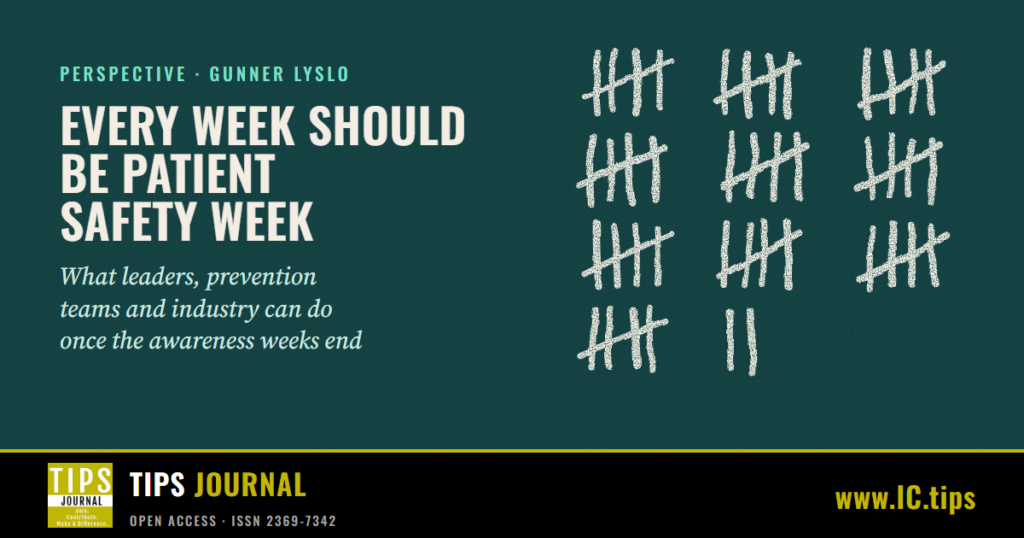
International Infection Prevention Week has ended for another year. The recognition was deserved, and the conversations mattered. The harder part comes now: keeping that attention through the rest of the year, when budgets, staffing and daily pressures all compete for it.
Where we stand
In July, the New England Journal of Medicine published the latest national survey of infections acquired in US hospitals. On a typical day in 2023, about 2.6% of hospital patients, roughly 1 in 38, had at least one healthcare-associated infection. In 2015 the figure was 3.2%, about 1 in 31.1,2 Among the hospitals that took part in both surveys, a patient’s risk of infection was 27% lower in 2023.1
That progress belongs to the infection preventionists, environmental services (EVS) staff and clinical teams who earned it. It still leaves an estimated 518,000 infections in US hospitals in 2023.1 Each one is a patient whose recovery was set back and a family who worried. Progress should make us more committed, not less.
The survey also found that about 60% of these infections were not linked to a medical device or procedure.1 Pneumonia was the most common. Device bundles have done a lot of good, but much of what remains will take prevention that goes beyond them.
Patients enter hospitals to get better, not to face additional risks
What has always troubled me is that we have come to accept a level of hospital-acquired infections that should make all of us uncomfortable. Patients enter hospitals to get better, not to face additional risks to their health. No patient or family walks through those doors expecting an infection or a preventable complication.
I often think about a simple question: Would I feel comfortable having someone I love receive care in a hospital where preventable infections are accepted as an unavoidable part of healthcare?
We’ve made meaningful progress, but I refuse to believe we’ve reached the limits of what we can prevent.
Starting with my own side of the table
I run a company that makes UV-C technology intended to achieve microbial reduction as an adjunct to manual cleaning, so I’ll start with industry. Our job does not end when the equipment is delivered. Hospitals deserve partners who help fit new technology into real workflows, train the people who use it and stay involved long after installation.
I’ve learned that getting a hospital to adopt new technology is one thing. Making it part of a sustainable infection prevention program is another. That takes listening to the people doing the work, understanding the pressures they face and being willing to stay involved when things don’t go as planned. We have a responsibility to help our customers succeed, not simply sell them another piece of equipment.
Research on environmental cleaning shows why follow-through matters. In a study of 36 US hospitals, only 48% of the surfaces tested with a fluorescent marker were actually cleaned during the room cleaning done after a patient left. After the hospitals gave cleaning staff structured education and regular feedback on their results, that rose to 77%.3 The improvement came from education, feedback and leadership support, and the authors concluded it could be achieved without substantial added cost.3 Industry should be held to that standard too.
Questions for senior leaders
Leaders have a standard to meet as well. A few honest questions:
- Does the infection prevention team have a real voice in purchasing and workflow decisions?
- Can EVS staff raise concerns about time, equipment or staffing and expect something to happen?
- When a team finds a gap, is there a plan and a named person responsible for closing it?
- Or has an appreciation week become a substitute for change?
Why prevention is hard to fund
Hospitals are not paid directly for infection prevention, so prevention programs are often asked to prove their worth in financial terms.4 That is hard when success means something never happens. An avoided infection has no dramatic recovery story. The patient simply goes home as planned.
Because that success is hard to see, its value is easy to write off as “soft dollars.” The Society for Healthcare Epidemiology of America has published a step-by-step method for making the business case for infection control, using the attributable costs of the infections a program prevents.4 That is why infection prevention, EVS and quality leaders need a louder voice when investment decisions are made. They are the people who can make that case.
We need to change the way we evaluate prevention investments. If we only look at the upfront cost, we’re missing the bigger picture. The cost of an infection extends beyond the financial impact on a hospital. It affects patients, families, caregivers and the capacity of our healthcare system. We should be asking not only what prevention costs, but what it costs when we fail to prevent infections that could have been avoided.
What a real commitment looks like
My hope is that healthcare leaders make one commitment their teams can see. Remove a workflow barrier that keeps coming back. Protect time for training. Fund a prevention priority that has waited too long. Then name who is responsible and check the result.
We are all in the patient safety business
Whatever our titles, we are all in the patient safety business. That shared responsibility connects hospital leaders, infection preventionists, EVS professionals, clinical teams and industry partners.
Patient safety doesn’t take a week off, and neither should our commitment to infection prevention. Awareness matters. But what we do after the awareness ends is what ultimately makes a difference.
Competing interests: Gunner Lyslo is Founder and CEO of Surfacide, LLC, which makes UV-C microbial reduction systems for healthcare environments, including the FDA-cleared Helios+ system.
References
- Chea N, Li R, Eure T, Ramirez RA, Nadle J, Lee JE, et al. Health care-associated infections in U.S. hospitals, 2023 versus 2015. N Engl J Med. 2026;395(3):255-66. doi:10.1056/NEJMoa2510881
- Magill SS, O’Leary E, Janelle SJ, Thompson DL, Dumyati G, Nadle J, et al. Changes in prevalence of health care-associated infections in U.S. hospitals. N Engl J Med. 2018;379(18):1732-44. doi:10.1056/NEJMoa1801550
- Carling PC, Parry MM, Rupp ME, Po JL, Dick B, Von Beheren S; Healthcare Environmental Hygiene Study Group. Improving cleaning of the environment surrounding patients in 36 acute care hospitals. Infect Control Hosp Epidemiol. 2008;29(11):1035-41. doi:10.1086/591940
- Perencevich EN, Stone PW, Wright SB, Carmeli Y, Fisman DN, Cosgrove SE. Raising standards while watching the bottom line: making a business case for infection control. Infect Control Hosp Epidemiol. 2007;28(10):1121-33. doi:10.1086/521852

 TIPS Master Series
 TIPS Interviews
 Science to Market